How an Older Woman Helped Me Understand Why Comfortable Sex Suddenly Became Painful
Before You Tell Yourself It Is Just Something You Have To Endure...
If you are dealing with pain during sex that was not there before, discomfort at the beginning or deeper inside, dryness, irritation, unusual discharge, a change in smell, or the strange feeling that something about your body is simply different — read every word on this page.
Especially if you keep thinking, “But why now?”
Because that question matters.
You remember when intimacy was normal.
Then something changed.
Maybe it started suddenly. Maybe it crept in slowly enough that you ignored it at first.
You told yourself you were tired.
You blamed stress.
You blamed your hormones.
You blamed your partner.
Then the next time came.
And you felt it again.
So you started changing things. New soaps. New washes. A different lubricant. Something someone recommended on WhatsApp. Maybe a pharmacy product. Maybe something a friend swore worked for her.
For a little while, you hoped.
Then the discomfort returned.
And that is when the real problem started.
Not just the physical discomfort.
The fear before intimacy.
The calculations in your head.
“Will it hurt this time?”
“Should I tell him?”
“What if he thinks I don't want him anymore?”
You may start avoiding the moment before it even happens.
You become tense.
You make excuses.
You turn away.
And sometimes you lie there wondering why something that used to bring closeness now makes you feel anxious.
That part can be incredibly lonely.
Because you may not even know what changed.
And when you don't know what changed, you can spend a lot of money trying to fix the wrong thing.
That was exactly where I found myself.
You do not have to keep guessing what changed. Start with a clearer way to look at the timeline.
GET THE GUIDE + BOTH BONUSES“I know. Because I carried it too.”
My Name Is Zara Amari

I'm not a doctor.
I'm not writing this pretending to diagnose anybody.
I'm a woman who became tired of not understanding a change in her own body.
For a long time, I thought the answer was to find the right product.
I thought if I could just make the discomfort disappear, everything would go back to normal.
I was looking for an answer.
What I eventually learned was that before you ask, “What should I use?” there is another question worth asking:
“What changed?”
That question became the beginning of everything.
The Part Nobody Warned Me About
I live in Nigeria, and like many women, I grew up hearing all kinds of advice about women's bodies.
Some advice was sensible.
Some was passed down because somebody's auntie said it worked.
And some of it was simply repeated so often that nobody questioned it.
When my discomfort started, I tried to be practical.
I changed products.
I paid for consultations.
I searched the internet late at night.
I listened to women in conversations that were supposed to be private but somehow always became advice sessions.
The problem was that every answer seemed to start with a product.
Try this.
Stop using that.
Buy this.
Use this before intimacy.
Wait a few days.
And if it happened again, I was back at the beginning.
What nobody was helping me do was step back and look at the timeline.
When was sex last comfortable?
When did it change?
What had changed in my life, routine, products, contraception, stress, intimacy, or body around the same time?
That was the missing piece.
And eventually, I had a conversation that changed the way I looked at the whole problem.
The Day Someone Asked Me A Different Question
The discovery did not happen in a laboratory.
It happened during a family gathering.
I had gone to spend time with relatives, eat, talk, and escape the pressure of everyday life for a little while.
There were women everywhere.
Aunts.
Cousins.
Older women sitting together and talking about everything from food to marriage to children.
I was quieter than usual.
One older woman noticed.
She did not announce it.
She did not embarrass me.
She simply waited until we were alone.
Then she asked:
“When did it become different?”
I froze.
Not “What medicine did you use?”
Not “What is wrong with you?”
Not “Which product have you tried?”
Just:
When did it become different?
For the first time, I went backwards instead of forwards.
I thought about the weeks before the discomfort.
I thought about the products I had started using.
I thought about changes in my routine.
I thought about stress.
I thought about intimacy itself.
And suddenly I realised how little attention I had paid to the period immediately before the pain began.
I had been trying to remove the symptom without understanding the change that came before it.
I had never looked at the problem that way.
I have never been more ashamed in my life.

The Discovery That Changed Everything
She noticed my face.
Then she moved closer and lowered her voice.
There was no judgement in it.
Only certainty.
“My daughter, you are not dirty. Your body is giving you information.”
That sentence broke something open in me.
I cried.
Not the polite kind of tears.
The real kind.
The kind that comes when you have been holding yourself together for too long.
“You keep looking for something to put on the problem. First understand what changed. If you don't understand the change, you can keep chasing the same problem around and around.”
“Think of your body like a house. If something in the house changes, you first find out what changed. You don't keep repainting the wall every morning and wonder why the crack comes back.”
The Change-Point Idea
Your body has a normal way of responding to changes around it.
When something changes — a product, routine, hormones, medication, contraception, stress, arousal, lubrication, irritation, or another factor — the experience you have during intimacy can change too.
The mistake is assuming that every episode of pain has the same cause. It doesn't. And unexplained or persistent pain deserves proper attention rather than endless guessing.
The practical starting point is to identify the change-point: the period between “this was comfortable” and “this became uncomfortable.”
“Don't keep treating the return. Find what keeps changing underneath it.”
I sat there thinking about the money I had spent.
The products.
The consultations.
The things I bought because somebody sounded confident.
And the emotional cost was even bigger.
I had spent so much time wondering whether I was somehow failing at intimacy.
It took one quiet conversation to make me realise I needed a better process.
Not another miracle product.
A process.
The Practical Framework I Eventually Built
I began documenting the questions that mattered.
What changed?
When did it change?
What happens before intimacy?
What happens during intimacy?
What products touch the area?
Are there other symptoms?
Is the discomfort new, recurring, severe, or getting worse?
And most importantly:
When should you stop experimenting at home and speak with a qualified healthcare professional?
The framework became simple enough to use at home and structured enough to stop me from jumping randomly from one solution to another.
I call it the Change-Point Method.
It is not a diagnosis.
It is not a promise that every cause can be solved at home.
It is a practical way to organise what you know, identify what changed, and decide what your next step should be.
Take a step back. The Change-Point Method helps you organise what changed and decide what to do next.
GET THE COMPLETE GUIDE NOW“Write it down. Follow the steps properly. And don't be afraid to get help when your body is asking for more than a home answer.”
The First Few Days: Nothing
The first thing I did was stop trying ten different things at once.
I started paying attention.
Day 1, I wrote down what I remembered.
Day 2, I looked at my routine.
Day 3, I checked what products I had introduced or changed.
Day 4, I reviewed what happened before, during, and after intimacy.
Nothing dramatic happened.
And honestly, that was frustrating.
I wanted an instant answer.
But I was learning something more useful: understanding the pattern takes patience.
Day 5: The First Sign
By the fifth day, I had stopped looking for a miracle.
I was simply paying attention to details I used to dismiss.
The important change was not some dramatic overnight transformation.
It was clarity.
I could finally see the sequence instead of one frightening symptom.
Day 6. Day 7. Then Something Became Clear.
By the end of the first week, I understood why the Change-Point Method mattered.
I was no longer asking, “What random thing can I try next?”
I was asking, “What changed, and what does that tell me about my next step?”
“For someone who had spent so long checking for the problem, being able to stop guessing was its own kind of relief.”
But there was still one important test.
What would happen the next time intimacy came up?
Friday Night
My husband reached for me.
And I noticed something before anything else happened.
I wasn't already panicking.
I wasn't calculating how quickly I could make an excuse.
I was present.
That mattered to me.
We talked first.
I told him what I had been experiencing.
He listened.
There was no dramatic movie moment.
There was simply a conversation between two people who had been affected by something neither of us fully understood.
That night taught me another lesson: intimacy should never require you to silently tolerate pain.
If something hurts, you can pause.
You can communicate.
You can seek help.
You do not have to prove love by enduring discomfort.
“It felt less like I had to fight my body and more like I had finally started listening to it.”
I Didn't Plan To Tell Anyone
At first, I kept everything to myself.
Then one friend asked why I had become so interested in the subject.
I told her.
She went quiet.
Then she said something I will never forget:
“I thought I was the only one.”
That conversation made me realise how many women may be asking the same question privately.
Why did sex suddenly start hurting?
Why now?
What changed?
What should I do before intimacy?
Could something I am using be contributing?
And when is it time to stop trying things myself?
Those questions became the reason I eventually turned my notes into a practical guide.
Why I Am Sharing This
I went back to the woman who first helped me look at the problem differently.
I told her what happened.
She laughed.
Not because the situation was funny.
Because she knew exactly how women can complicate something that becomes much clearer when you slow down and look at the sequence.
I asked if I could document what I had learned.
She agreed.
“Do it. But don't make women afraid. Help them understand. And make sure they know they are not dirty or broken. They need to know what changed and when they need proper help.”
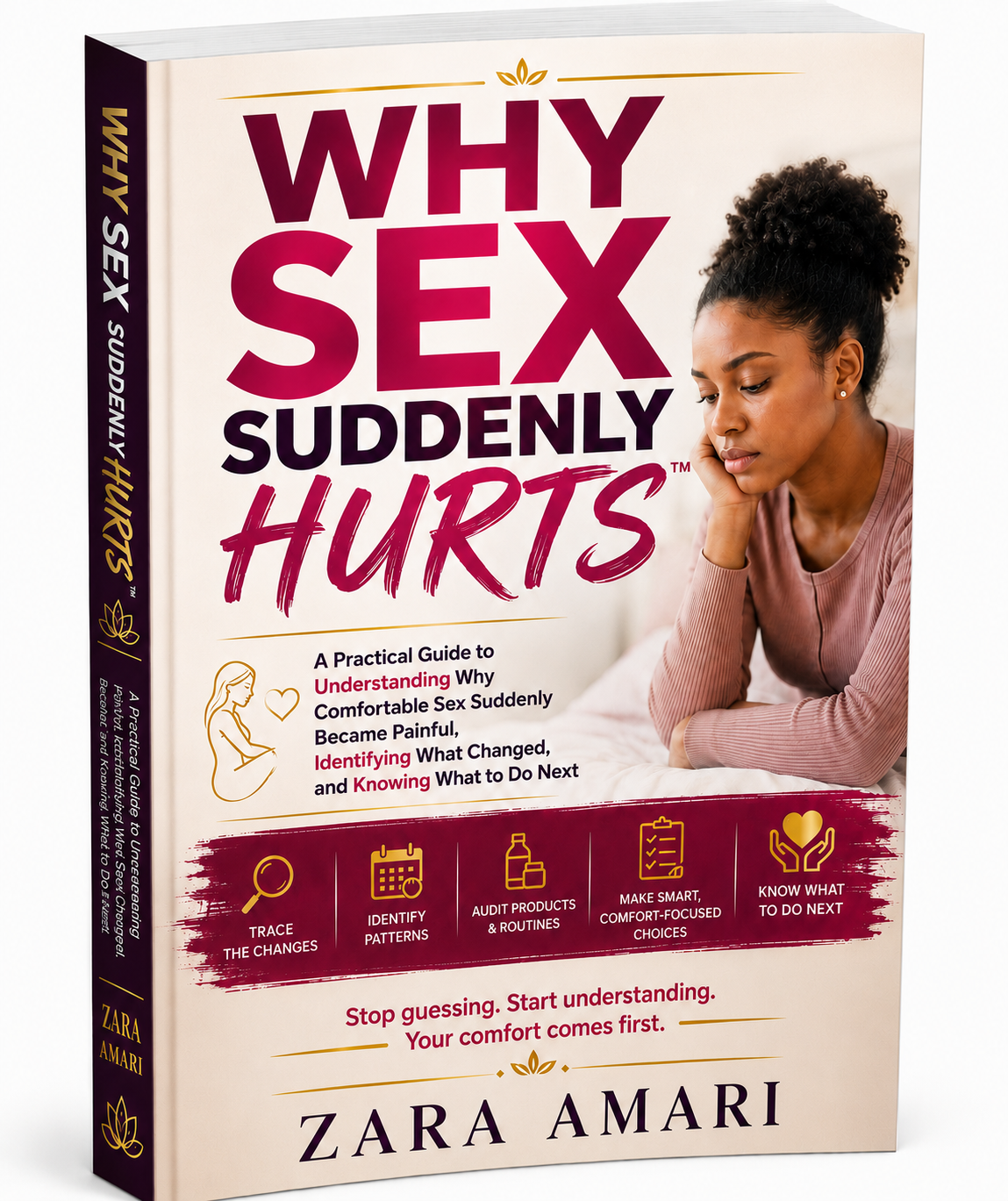
Now Available: Why Sex Suddenly Hurts
A practical guide to understanding why comfortable sex suddenly became painful, identifying what changed, and knowing what to do next.
I put the framework, the questions, the practical checks, the things to pay attention to, the things to avoid guessing about, and the signs that mean you should seek professional help into one simple guide.
No complicated lecture.
No shame.
No pretending that every woman's body is the same.
Just a clearer way to think about a confusing problem.
Inside This Guide, You'll Discover:
- The Change-Point Method — how to work backwards from when sex was comfortable to identify what changed.
- The Before-and-After Checklist — a practical way to compare your routine, products, timing, and circumstances.
- Could Something I'm Using Be Contributing? — how to review products and habits without automatically blaming one thing.
- What To Do Before Intimacy — practical preparation and communication steps that reduce guesswork.
- The Things You Should Stop Guessing About — when home experimentation is not the right next step.
- Your Personal Change-Point Worksheet — a simple private record you can complete at your own pace.
- When To Seek Professional Help — situations where persistent or severe pain should be evaluated.
- Your Next-Step Plan — how to turn what you have noticed into a clear next action.
Compare That To What You May Already Have Been Spending
Maybe you have bought a product because a friend recommended it.
Maybe you have paid for something online.
Maybe you have tried changing products over and over.
Maybe you have spent money without ever getting a clear explanation of what changed.
There is another cost too.
The cost of continuing to guess.
- Random products — you don't know whether they address the reason your pain started.
- Advice from social media — one woman's experience is not automatically your explanation.
- Repeated self-treatment — experimenting repeatedly can delay appropriate evaluation.
- Ignoring the discomfort — pain during sex is not something you have to silently tolerate.
- Avoiding intimacy completely — avoidance can create emotional distance without solving the underlying issue.
The real cost is the anxiety, confusion, embarrassment, and relationship strain that can grow when you don't understand what is happening.
And I Didn't Want To Stop With The Guide
Once I had put everything together, I realised there were two other practical pieces that could make the process easier.
Because sometimes the question isn't only “Why is this happening?” It is also “What can I check before intimacy?” and “Could something in my routine be contributing?”

Bonus 1: The Before-Intimacy Comfort Checklist
A simple checklist designed to help you prepare your body, create a comfortable environment, communicate clearly, and think through the things that may affect how you feel before intimacy.
Bonus included with your purchase.
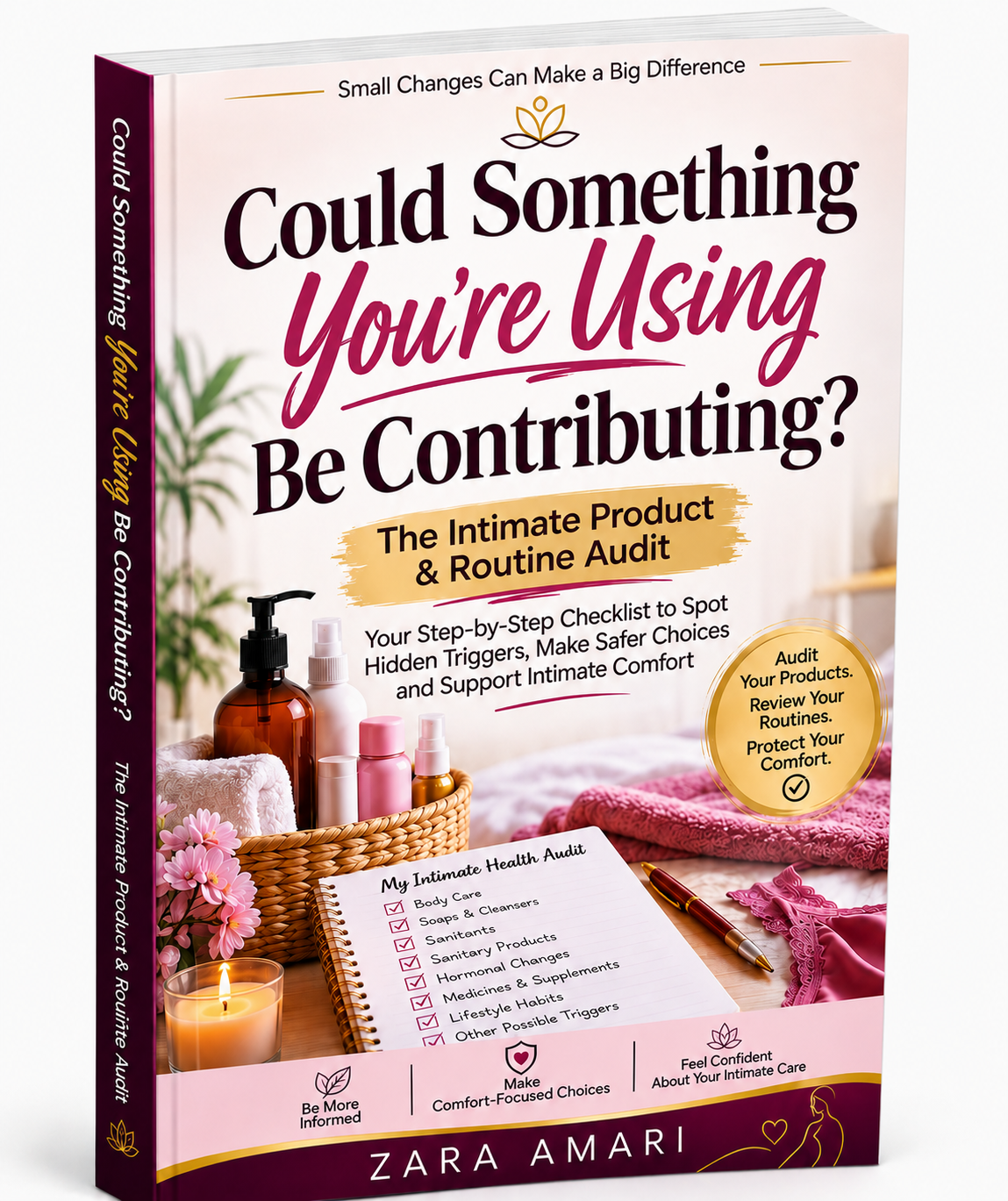
Bonus 2: The Intimate Product & Routine Audit
A practical step-by-step audit to help you review the products, routines, body-care habits, medications, supplements, and other changes you may want to discuss with a qualified professional.
Bonus included with your purchase.
Everything You Get Today
Instead of getting only the main guide, you receive the complete digital bundle with both practical bonus resources.

What Women Have Said After Going Through The Guide
These are the kinds of messages that matter most to me — not because they promise a particular medical outcome, but because they show what happens when a woman finally has a structured way to think about a confusing change.
Now You Have Two Choices
Keep Guessing
Keep wondering what changed.
- Try another product because someone recommended it.
- Search another post late at night.
- Hope the discomfort disappears on its own.
- Keep asking yourself, “Why now?”
You may eventually find an answer — but you are still guessing.
Know What To Do Next
Use a structured process to understand what changed.
- Trace the change-point.
- Review your products and routines.
- Prepare more intentionally before intimacy.
- Know what questions to ask and when professional help matters.
You don't have to diagnose yourself. You simply stop approaching the problem blindly.
Get The Guide + Both Practical Bonuses
Total value: ₦19,500
Get the complete digital bundle today.
GET THE GUIDE + BOTH BONUSESOne-time payment. Digital delivery.
GET IT NOW + BOTH BONUSESOne Last Thing...
Picture yourself one month from today.
Will you understand the timeline of what changed?
Will you know what questions to ask?
Will you feel more confident talking about the discomfort instead of hiding it?
Will you know when it is time to stop experimenting and get professional help?
Will you approach intimacy with more understanding and less fear?
Now picture yourself one month from today if you close this page.
You may still be wondering the same thing.
Why did sex suddenly start hurting?
The difference between those two versions of you begins with whether you choose to understand what changed.
If You Have Read This Far And You Are Still Hesitating...
Don't let embarrassment make the decision for you.
You deserve to understand what is happening in your own body.
And if your pain is severe, persistent, recurrent, or accompanied by other concerning symptoms, investing in proper medical evaluation may be more important than buying any digital guide.
The guide is simply there to help you organise the questions and information you may otherwise keep carrying around in your head.
Stop guessing. Start paying attention. Choose clarity.
P.S. You don't have to be ashamed of asking why something changed.
P.P.S. You don't need another random recommendation. Start with understanding the timeline.
P.P.P.S. If the pain is persistent, severe, recurrent, or concerning, don't delay professional medical care while trying to solve it yourself.
With care for your wellbeing,
Zara Amari
Frequently Asked Questions
How is the guide delivered?
After payment, the guide can be delivered digitally through the email address and/or WhatsApp details provided during checkout.
Are the things discussed in the guide easy to understand?
Yes. The guide is written in plain, everyday language rather than filling every page with complicated terminology.
What if the pain has been happening for a long time?
The guide can help you organise what has changed and what questions to consider. However, persistent or severe pain should not simply be ignored. A qualified healthcare professional should evaluate ongoing or unexplained pain.
What if my partner doesn't understand?
The guide can help you understand how to communicate about the discomfort without turning the conversation into blame or embarrassment.
Why is this different from everything else?
It starts with a different question: not simply “What should I use?” but “What changed between when sex was comfortable and when it became painful?” That change-point can help you organise the problem rather than repeatedly guessing.